
How God Tethers Us to Hope When We Feel Hopeless

May the God of hope fill you with all joy and peace in believing, so that you may abound in hope by the power of the Holy Spirit.
Romans 15:13, NRSVUE
Hope Holds Us
What do you have in your in-between space? A mustard seed of faith among an overgrown tangle of doubts or fears? Are you willing to consider that this may be enough?
What I’ve found—and believe you can find too—is that God’s quiet kindness is there, unfazed by our complexity, at rest in the tension between who we are and who we’re becoming. Even when we’re floundering.
But hope isn’t gone, and it won’t leave. You don’t have to attain it or even hold on to it. It’s already holding you because God—“the God of hope”—is holding you, and that doesn’t change even if you’ve let go.
In a world that can feel so unkind, so noisy, so jilted and off-center, we can get ourselves in knots trying to figure out how to survive with hope intact, but we don’t need to be able to hold on tighter; we’re already tethered because God does the tethering. God holds on when we can’t.
Framing Crisis as a Catalyst
The word crisis was first adapted for English use as a medical term to describe a crucial turning point in a disease. In this context, crisis was the particular point—the decisive moment—when the disease made a pivot in one of two directions: either toward healing and recovery or toward decline and death. As much as the word today conjures up all sorts of negative images, it began as a neutral word: a point of decision—toward healing or toward decline—a word of movement, development, openness.
The quiet kindness of God is present with us no matter how dark the darkness gets or how disordered we feel or how little we know how to find a way forward through a crisis.
Hope Persists
Consider the following verses from the book of Isaiah 43:18–19.
Forget the former things;
do not dwell on the past.
See, I am doing a new thing!
Now it springs up; do you not perceive it?
I am making a way in the wilderness
and streams in the wasteland.
I wonder if the prophet Isaiah could have had any inkling how much some of us today, would need to be asked the same question he asked the nation of Israel all those years ago: Do you not perceive it?
Do you perceive it? I don’t always. But even my lack of perception doesn’t hinder God’s promise to stay with me (Ps. 23:4) or the reality of what God can accomplish within the most difficult of circum–stances (Rom. 5:3–5; Heb. 4:16). Hope won’t be deterred. Hope is a practice that steadies us when we feel flimsy and a promise that anchors us (Heb. 6:19).
Do you perceive it? If not yet, keep practicing; keep looking and listening.
Hope persists. No specific action is required for that to be true. But if you don’t feel like you can perceive it or can’t yet perceive it, ask yourself this question and see what you come up with: What is one small thing that is keeping me tethered to hope today?
Just answer for today.
Already Tethered
We are tethered to hope not because we feel it but because the God of hope does the tethering.
Let God write the words in your soul, and then trace and retrace them as many times as you need to.
You’re already tethered.
In His Word
Read Psalm 23. Which verse stands out to you most today as something you needed to hear from the Lord?
In Your Life
Are you feeling hopeless? Is there an area of your life that feels heavy or empty? Pray and ask God to reveal His presence to you quietly. He is closer than you think, and He will not let go.
We Recommend
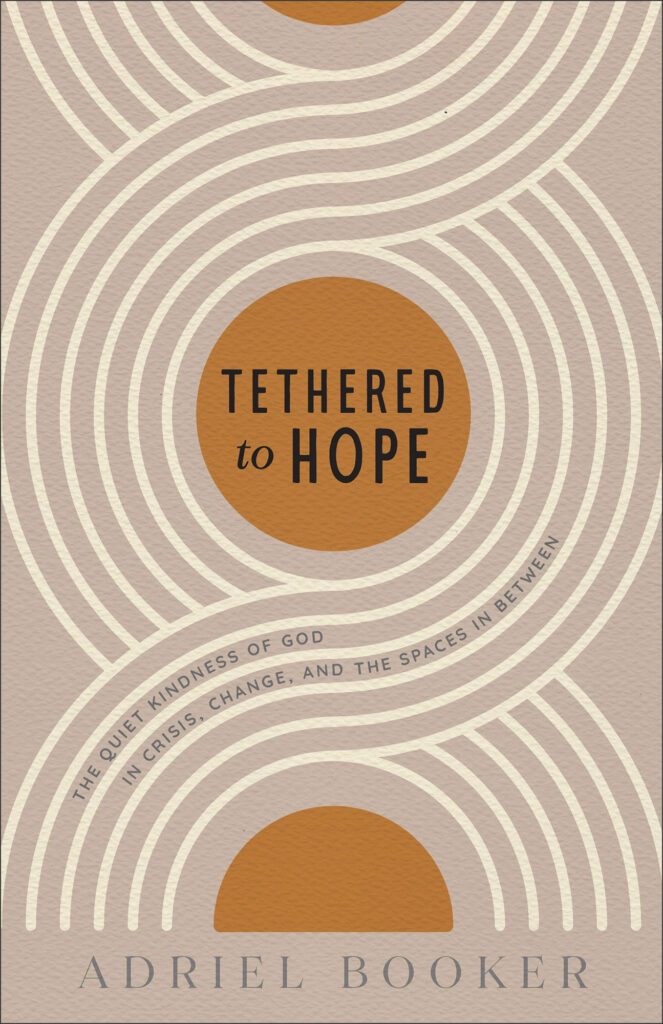
We recommend the book Tethered to Hope by Adriel Booker. One of the things we love about this book is how Adriel helps you perceive God’s quiet kindness that has been there all along, hidden in plain sight on the underside of crisis.
Let’s Connect
Adriel Booker is a writer, speaker, and curator who believes the best things in life happen while gathered around the table. She lives with her family among the gum trees and sea breezes of a small town on Ngarrindjeri Country in the Fleurieu Peninsula, South Australia. Adriel is the author of Grace Like Scarlett, writes at The Foundry on Substack, and can also be found @adrielbooker and AdrielBooker.com.