Why Belonging Is the Foundation Your Family Needs

In a world that glorifies busyness, upgrading, and constant change, one of the most radical things a family can do is simply stay — stay present, stay connected, and stay committed to one another through every season of life.
This is the practice of stability. And it may be the most important thing you build in your home.

What Stability Actually Means
Stability isn’t about staying in the same house or the same town. It isn’t about having a picture-perfect family or a conflict-free home. At its core, stability centers on a commitment to being fully present in your family’s everyday moments — the daily conversations and interactions with one another — in good times and bad, throughout life.
It is primarily about two things: consistency and belonging.
Consistency means staying connected and committed to each other even when life’s circumstances change and busyness threatens to dilute the bonds you share. Belonging is deeper — it is about emotional connection, identity, and acceptance. It helps every member of your family feel understood and valued, secure in the knowledge that they are an integral part of something bigger than themselves. Belonging isn’t just about fitting in. It’s about being wholly embraced for who you are.
Together, consistency and belonging forge a nurturing environment where families can reflect, learn, and grow — spiritually and relationally.
Why It Matters More Than Ever
We are conditioned to search for an upgrade — something newer, easier, or more exciting. But no matter how many times we go looking for something new, we ultimately can’t escape ourselves or the realities of our relationships with one another.
As one father wisely said, “Wherever you go, there you are.”
Author Jonathan Haidt, in The Anxious Generation, highlights that although today’s children are more digitally connected than any previous generation, they are relationally and socially disconnected. They lack acceptance and belonging. Haidt notes that people don’t get depressed when they face threats collectively — they get depressed when they feel isolated, lonely, or useless.
Your family can be the antidote to that isolation.
What Stability Looks Like in Real Life
Practicing stability doesn’t require grand gestures. It is built in the small, repeated moments — the rhythms your family can count on. Here are four practical ways to begin:
Show up consistently, even when it’s hard. Resist the urge to check out or walk away without resolution. Lean in with a “seek to understand” mindset, asking deeper questions about tensions rather than pulling away.
Create family traditions. Traditions don’t need to be elaborate. Saturday sock-sliding contests, Sunday church, annual beach trips, or a standing board game night all count. Big or small, they remind your family that you are in this together.
Ask the deeper questions. Slow down long enough to discuss who God made each person in your family to be and what your shared values are. These conversations build bonds that carry a family through hard seasons.
Give your children roots. Where are we? In the presence of God and each other. Who are we? Image bearers of God. Whose are we? We belong to God and to one another. As Ecclesiastes 4:9–10 reminds us, two are better than one — because we can help each other as we navigate life together.
Reflection
Which rhythms and traditions in your family are creating a genuine sense of belonging? Are there moments of disconnection where you could choose to stay and lean in rather than pull away? Consider one small, repeatable tradition you could introduce this week — something simple that says to your family: we belong to each other, and we’re not going anywhere.
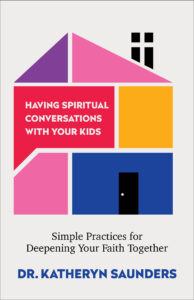
If you have enjoyed this blog post, check out the book Having Spiritual Conversations with Your Kidsby Dr. Katheryn Saunders. We love how she helps create stronger relationships and deeper faith with your kids and teens.

Katheryn Saunders has a DMin in leadership and spiritual formation from Portland Seminary, focusing on next-generation faith and giving. She also has a master’s degree in teaching and is a licensed chaplain. Dr. Saunders has more than twenty-five years of experience working in the Christian nonprofit world, including more than a decade working for World Vision, where she is currently regional director for philanthropy for the northwest region.