
Parents of Teens, Here’s What Not to Say
Parents of teens often struggle with tough conversations. Learn what not to say, how to avoid exasperating your teen, and how to build trust instead.

What Not to Say
Having conversations with our teenagers about important issues can be really tough. It’s easy for our teens to misunderstand us and often hard for them to see the big picture behind our intentions. Next thing we know, the conversation takes a bad turn. We know our teens. Their weak areas. Their vulnerable points. We know where their buttons are, and it would be easy to push them. But that would be a form of exasperating our kids, which violates a clear command God gives parents in Ephesians 6:4:
Fathers, do not exasperate your children; instead, bring them up in the training and instruction of the Lord.
What does exasperating our kids look like?
- Accusing them—especially if we claim to know their motives when only God does.
- Interrupting them without asking for permission first.
- Acting annoyed or impatient with them as they talk.
- Arguing or debating them as they try to explain themselves.
- Laughing at them. This is especially lethal.
- Using classic manipulating or controlling tactics, like guilting them into doing what we want them to do.
- Finishing their statements rather than giving them the time to collect their thoughts.
- Failing to hear them out, even though we’re absolutely sure we know where they’re going with their conversation.
- Intimidating. Threatening. Using fear instead of love to get them in line.
These are bully tactics—every single one. If we exasperate our kids, we’re following the enemy, not the Lord. Let’s not make our enemy’s job easy. We should speak the truth, but only in love.
Conversation Killers: Have you ever used any of these?
Here are some specific “conversation killers,” things we want to avoid saying when talking with our kids—no matter how much we may feel like it.
“When I was your age . . .”
Here’s the sad truth: For the most part, they don’t care about our life as a teenager.
“Someday, when you have your own home, you can live any way you want. But while you live under my roof, you’ll do it my way.”
Okay, it is very tempting to say this—and our enemy hopes we do. We’re the adults, and we’ve got to be more together than to use an inflammatory, belittling statement like this one.
“I don’t care what you want/think.”
But we absolutely do care what our teens think, right? We’d do anything to rewind the clock somehow, to go back to when they adored us. A comment like this will absolutely push them further away.
Also, this comment is a lie. We don’t want our teens lying to us, so we shouldn’t lie to them.
“You always . . .” or “You never . . .”
That’s not completely true, is it? When we don’t acknowledge that our teens do get it right sometimes, that gives them less incentive to get it right ever.
“I don’t care what your friend’s parents let them do.”
We’d better care. These are the friends who may have more influence on our teenagers than we do.
“The Bible says . . . !”
Now, of course we want to use the Word. It’s the source of truth. It’s also a massively powerful tool. We must be very careful of our tone when we bring Scripture into the discussion. We want to win their heart, not simply the argument. Of course we’ll want to use Scripture. But we’ll want to use it to show God’s love for us—and how he knows and wants what’s best for us.
“You’ll do what I say because I said so / because I’m the parent/boss.”
Statements like these aren’t going to lead us to anything good. They may be true, but they’re bully talk. Seriously: This is parental bullying. And nobody thinks that what a bully does is good or right or fair. If we make statements like these, here’s what our teens hear: “I’m more powerful than you—and I hold all the cards. You’ll do it my way or else.”
I’ve seen many parents use these types of conversation killers—and sometimes they got positive results. But only temporarily.
Instead, we want to help our teens grow into the kind of people God intended them to be. That will be easier to do if we avoid saying the things on this list.
Bridges are easy to destroy but hard to rebuild.
Reflection:
Parents of teens, do you find yourself speaking to your teens in these ways? How can you change how you converse with your teen to remove language that halts further conversation?
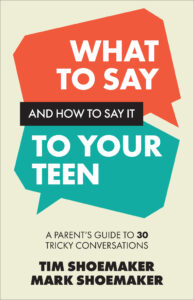
If you enjoyed this post, check out the book What to Say and How to Say It to Your Teen by Tim Shoemaker and Mark Shoemaker. From shifting views on gender to questioning faith to struggling with honesty or respect or porn, the teen years are tough. They’re also some of the most important years for you to offer guidance. This book will help you handle 30 of the trickiest conversations you need to have with your teen.

Tim Shoemaker is the author of more than 25 books and is a popular speaker at conferences and schools around the country. He is a regular contributor to Focus on the Family’s Clubhouse and Clubhouse Jr. magazines. Happily married for more than 40 years, Tim lives in Illinois and still loves working with youth.

Mark Shoemaker is a Moody Bible Institute and Seminary graduate, has served as an adjunct professor, and has been a youth and family pastor since 2011. Happily married for over 15 years, Mark oversees youth and college ministries at The Bridge Community Church in Illinois.

100 Words of Affirmation Your Son/Daughter Needs to Hear
Matt and Lisa Jacobson want you to discover the powerful ways you can build your children up in love with the beautiful words you choose to say every day–words that every son and daughter needs to hear.
These affirmation books offer you one hundred phrases to say to your son or daughter – along with short, personal stories and examples – that deeply encourage, affirm, and inspire.
So start speaking a kind and beautiful word into their lives daily and watch your children–and your relationship with them–transform before your eyes.